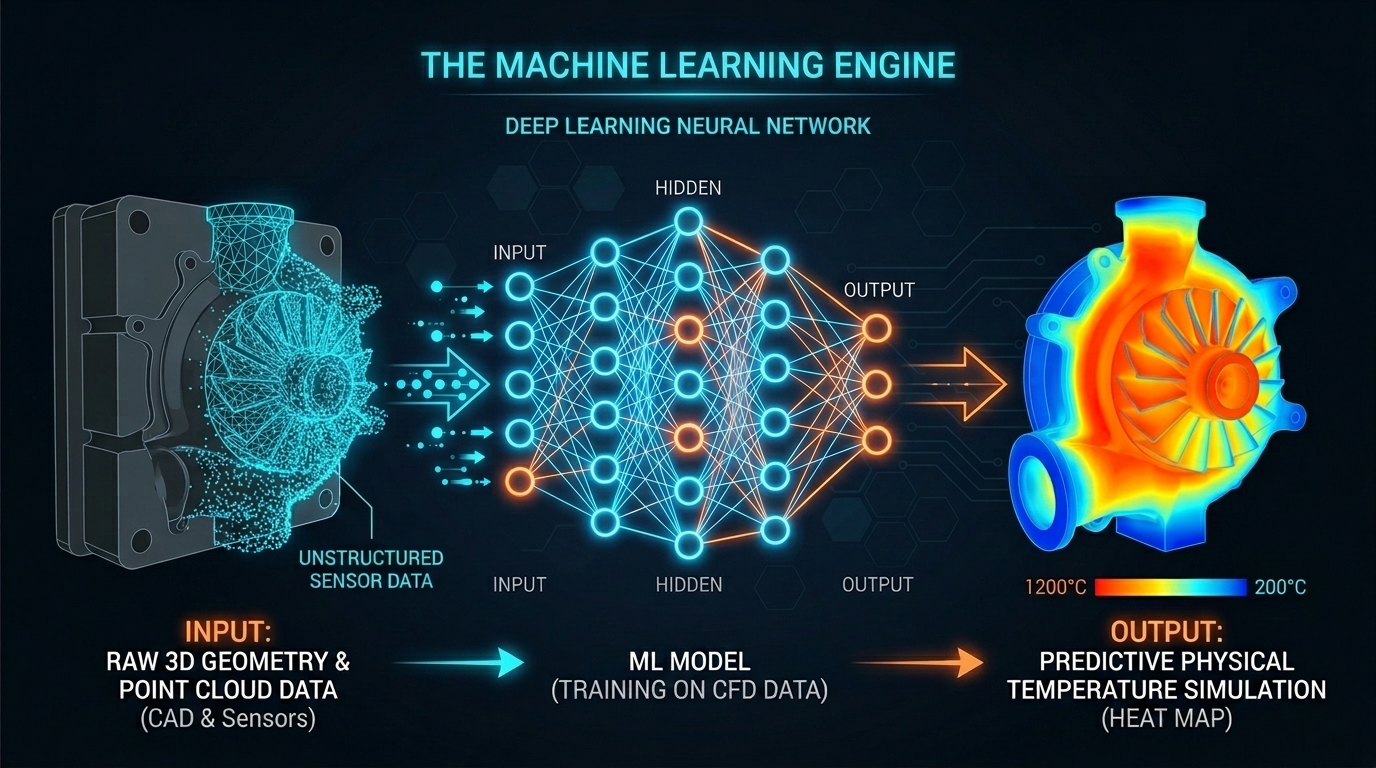
The Problem
In metal casting — the process of pouring molten metal into molds to produce parts — the quality of the final part depends critically on how the metal cools and solidifies. Two phenomena are especially critical:
- Temperature Distribution: Uneven cooling creates internal stresses and warping. Predicting the temperature distribution through the solidification process allows engineers to optimize mold design and cooling channels before production.
- Porosity: Shrinkage during solidification creates internal voids (porosity) that weaken the part. Predicting where and how much porosity will form is essential for quality control.
Conventional physical simulation methods can compute these distributions, but they are often computationally expensive. This research investigated whether machine learning approaches could help accelerate this type of prediction by combining data-driven models with knowledge of the underlying physical processes.
Research Approach
The research explored physics-informed machine learning as a way of combining data-driven prediction with knowledge of the physical processes involved in casting.
A central challenge in this domain is dealing with the complex, arbitrary shapes of cast components. The project therefore investigated machine-learning approaches for working with complex 3D casting geometries.
Prediction Targets
The research investigated the prediction of temperature and solidification-related properties in complex cast components.
Results
The project explored the feasibility of using machine learning to accelerate aspects of casting simulation while preserving the physical context of the problem. The work formed part of ongoing research at GFaI.
Technical Stack
- Python
- PyTorch
- Machine Learning
- 3D Point Cloud Processing
- Scientific Computing
- Data Visualization
Reflection
Working on this research provided a deep dive into the fascinating intersection of machine learning, physical simulation, and 3D geometry applied to real-world engineering problems.
It deepened my appreciation for the complexity of industrial processes and the unique challenges involved in making machine learning models operate within the constraints of physical reality, rather than just finding patterns in abstract data.